

A glass wine room is part cellar, part architecture, part art. It lets you store wine the right way while making it a true feature in your home. Done well, it looks clean and modern, feels premium, and protects your collection for years.
But here is the truth: Glass wine rooms are less forgiving than traditional enclosed cellars. If the wine cellar design is off, you will fight foggy glass, condensation, uneven temperatures, and wine that ages too fast. Wine storage works best when the temperature stays steady, light is controlled, and vibration is low. Experts consistently point to cool, stable conditions (often referenced as classic “cellar” ranges) and minimizing swings as the big win.
This guide helps you pick the right glass wine room for your space, your collection, and your lifestyle. It also gives you design ideas you can actually use, plus the key technical checks that separate a beautiful glass room from an expensive headache. Keep reading to learn about our meticulous process.
The Evolution Of The Modern Wine Cellar
Wine cellars used to be hidden. They were back rooms, basements, or caves. The goal was simple: Keep wine cool and steady. Traditional wine cellars worked because thick walls and small openings helped hold temperature and humidity, while blocking light.
Homes changed. So did how people buy and enjoy wine.
Today, many owners want their collection to be visible. They want a display that feels like a private lounge, a gallery, or a high-end hospitality space. A glass wine room fits that shift. It turns storage into an experience.
At the same time, the science behind good storage did not change. The big risks are still the same:
- Heat and temperature swings can push wine to age too quickly and lose freshness.
- Bright light, especially UV, can damage wine over time.
- Vibration can disturb long-term aging.
- Very dry air can dry corks; very damp air can create mold issues around a room.
Most credible guidance emphasizes steady, cool temperatures and avoiding light and big swings.
The challenge with modern wine cellars is combining “showpiece” design with “quiet control.” Glass makes that harder because it can transfer heat faster than a solid insulated wall, and it can invite condensation if the room is colder than the surrounding space. Building Science Corporation’s wine cellar guidance calls out how different wine rooms are from typical indoor rooms, and why enclosure details matter.
So the evolution is not just style. It is a higher standard. A premium glass wine room must look effortless while doing real work behind the scenes.
Before You Choose A Design, Answer These 6 Questions
You can waste weeks looking at inspirational photos without clarity. Start here. Your answers will point to the best layout and the right technical approach:
1) Is your goal aging, display, or both?
- Display-first: You open bottles often. You want it to look stunning. You may keep fewer “long-aging” bottles.
- Aging-first: You want stability and capacity. You want fewer temperature swings and less light.
- Both: Most owners land here. You need zones, or at least a design that balances access and protection.
Storage guidance from WSET and Purdue Extension stresses that stable, cool conditions matter for long-term development.
2) How many bottles do you want to store, really?
Count what you own today. Then decide what “full” looks like in 3-5 years.
A simple rule: Design for at least 1.5x today’s bottle count. It avoids a room that looks full on day one and feels cramped later.
3) Where will it go?
Glass wine rooms work best when placed:
- Away from direct sun
- Away from heat sources (kitchens, mechanical rooms)
- Away from constant vibration (near heavy doors, gym equipment, loud speakers)
Decanter’s storage guidance emphasizes avoiding bright light and minimizing temperature changes. Placement is part of that.
4) What is your surrounding room like?
A glass wine room inside an air-conditioned home is easier than one placed in a hot, sunlit space. The bigger the difference between the wine room temperature and the surrounding temperature, the greater the risk of condensation you’ll have on the glass.
5) What is your tolerance for visible tech?
Some owners want zero visible vents and hardware. Others are fine with seeing a sleek grille or a clean ceiling supply. Your choice impacts system options and cost.
6) What does “premium” mean to you
Premium can mean:
- Museum-like lighting
- Perfect sightlines
- Seamless door hardware
- Quiet operation
- Strong materials that feel architectural
Define it now, not mid-build.
Top Custom Glass Wine Room Design Ideas
Below are design directions that consistently work in premium homes. Each idea includes: Best use, ideal placement, and key technical notes so you avoid common issues:
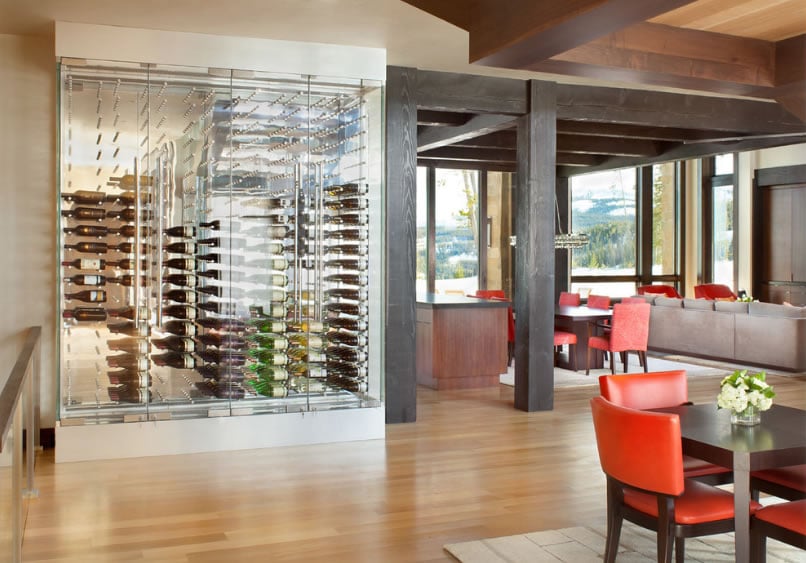
The Glass Enclosed Wine Wall
This is the modern classic: A full-height glass enclosure with racking that reads like a feature wall.
Best for
- Display-forward collections
- Tight footprints
- Homes where you want impact without giving up a whole room
Where it shines
- Dining rooms
- Hallways leading to entertaining spaces
- Open-plan great rooms
Design moves that elevate it
- Full-height glass panels with minimal seams
- A strong vertical racking pattern (symmetry reads expensive)
- A clean base detail (concealed curb or flush threshold)
- A simple bench or a single hero pedestal inside
Technical notes that matter
- Plan for controlled lighting. Light is a known risk in wine storage, so use low-UV, low-heat LED, dimmable, and keep it off when not needed.
- If the wine wall is colder than the space around it, the glass can fog. That is a design and enclosure problem, not “bad luck.” Proper insulation strategy and vapor control are critical in wine cellar enclosures.
The Walk-In Glass Wine Room
This is the statement piece: A true room with a glass perimeter, designed like a boutique cellar.
Best for
- 400+ bottles
- Owners who want a destination space
- Those who want a tasting moment inside
Where it shines
- Near the kitchen but not in the kitchen
- Between a lounge and a dining room
- Adjacent to a home theater or bar
Design moves that elevate it
- A centered door aligned to a sightline
- A mix of display and bulk storage (do not make everything “label out”)
- A feature ceiling (wood slats, dark panels, or subtle coffer)
- One strong material story: Metal and glass, or warm wood and stone
Technical notes that matter
- Stability matters more as the collection grows. Purdue Extension notes that wine aging reactions are influenced by storage temperatures, and traditional cellar ranges are built around that reality.
- Door sealing is everything. A beautiful door that leaks air will create constant cycling and swings.
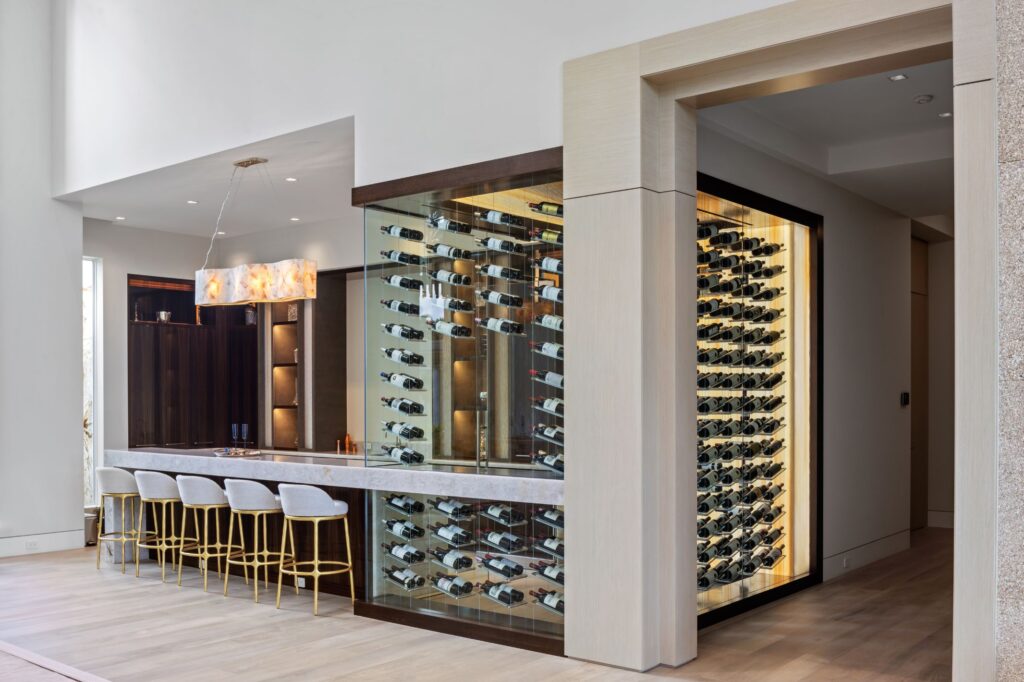
The Glass Corner Showcase
A two-sided glass corner enclosure gives you depth and drama without a large room.
Best for
- 150-600 bottles
- Open-concept homes
- People who want visibility from multiple angles
Where it shines
- At the edge of a dining room
- Near a staircase landing
- Beside a bar area
Design moves that elevate it
- Use the corner as a “spine” with racking wrapping both sides
- Build a clean ceiling reveal that frames the glass
- Add a single vertical lighting line, not a grid of spotlights
Technical notes that matter
- Corners can be harder to seal and insulate. Detail the junctions carefully. Wine rooms are specialty enclosures and need different thinking than typical interior glass partitions.
The Double-Sided Room Divider Wine Room
This creates a glass wine room that divides two spaces. You get “wow” from both sides.
Best for
- Homes with large open areas
- Entertaining-focused owners
- Collections that should be seen, not hidden
Where it shines
- Between the dining and the living room
- Between the lounge and the bar
- Between the foyer and the great room
Design moves that elevate it
- Keep the structure thin: The more it looks like a clean glass plane, the more premium it reads
- Use racking that looks architectural, not retail
- Consider a “shadow gap” detail where the glass meets the ceiling and floor
Technical notes that matter
- Heat loads can be higher because both sides are exposed to the conditioned space. System sizing and airflow design must match the exposure.
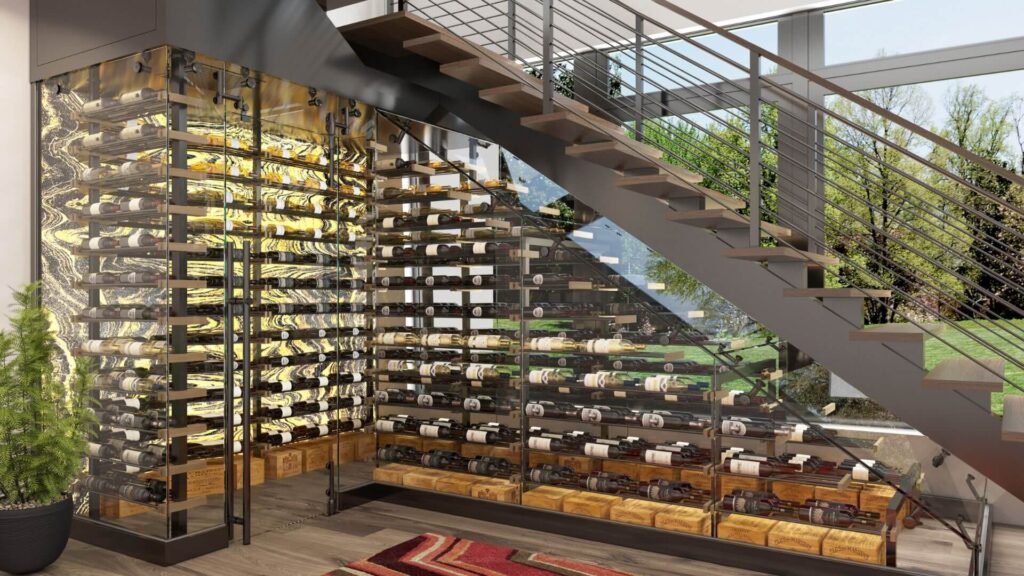
The Under-Stairs Glass Wine Room
This is one of the smartest uses of “dead space” in a home. Done right, it becomes a feature.
Best for
- 80-300 bottles
- Homes with strong stair architecture
- Owners who want a compact showpiece
Where it shines
- Main floor staircases near entertaining areas
Design moves that elevate it
- Match the stair lines (follow the slope cleanly)
- Use darker interior finishes so the bottles read better
- Add a small display niche for magnums or rare bottles
Technical notes that matter
- Under stairs often hide ducts, returns, and framing complexity. Early planning avoids ugly compromises later.
- Sun exposure from nearby windows can be a problem. Decanter’s guidance to keep wine away from bright light is especially important here if the stair zone is bright.
The Kitchen-Adjacent Glass Wine Room
This is popular, but it needs discipline. Kitchens are hot zones: Ovens, dishwashers, and constant activity.
Best for
- Owners who entertain often
- Collections that turn over (you open bottles regularly)
Where it shines
- Near but not inside the kitchen work triangle
- Near a pantry or dry bar
Design moves that elevate it
- Keep glass clean and minimal
- Use strong organization: Reds, whites, champagne, magnums
- Add a small “service ledge” outside the room for staging
Technical notes that matter
- Temperature swings are the enemy. WSET stresses cool, regulated storage for best development, and kitchens fight that by nature.
- Avoid placing the enclosure where it gets direct heat from appliances.
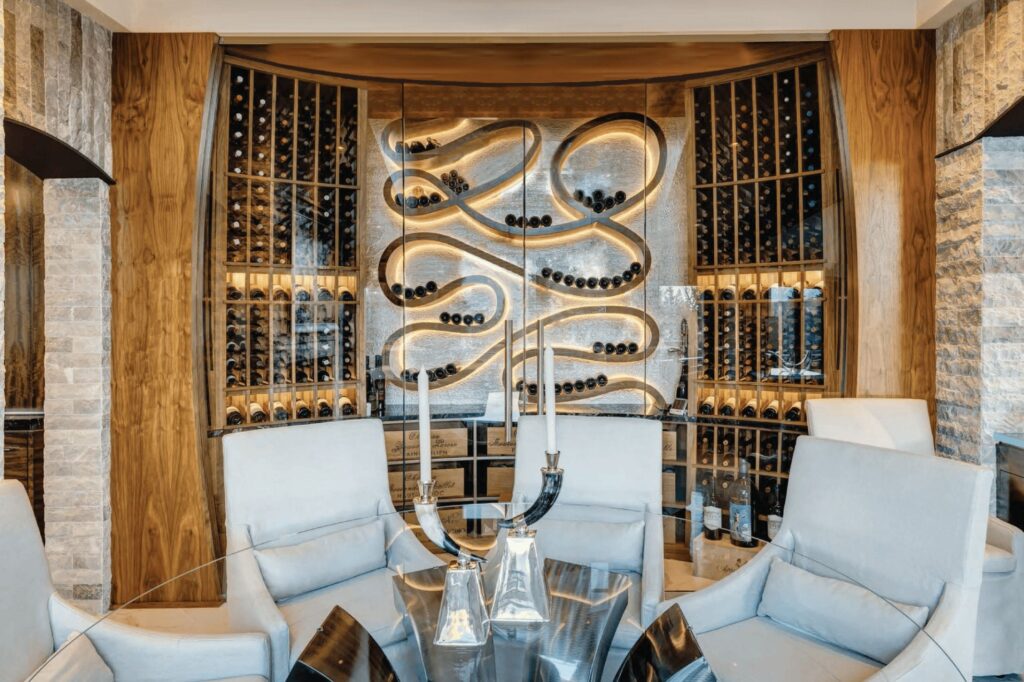
The Glass Wine Room With A Tasting Nook
This is where luxury shifts from “display” to “experience.”
Best for
- 500+ bottles
- Owners who host
- Collectors who want a calm ritual space
Where it shines
- Near a lounge or bar
- Off a library or private office
Design moves that elevate it
- A narrow bench and a small table, not a full dining set
- Soft lighting and darker finishes
- A single hero wall for label-forward display
Technical notes that matter
- You are adding people to a controlled environment. Ventilation, comfort, and condensation control must be planned. General HVAC standards commonly limit indoor relative humidity for occupant spaces to reduce microbial risk, which can conflict with “traditional cellar” humidity expectations if you treat the space like a normal room. That is why wine room design is its own category.
The Hybrid Glass Room + Hidden Bulk Storage
This is the best “value to performance” play for many serious collectors.
Best for
- Mixed collections
- People who want the showpiece but also want capacity
Where it shines
- Homes where you can carve back rooms or custom wine closets behind the glass display
Design moves that elevate it
- Front zone: Label-forward display, dramatic lighting
- Back zone: Dense bottle storage, darker, simpler
- Keep the transition clean, so it still feels designed
Technical notes that matter
- This supports better long-term aging by reducing light exposure for most bottles, aligning with standard storage guidance.
Materials And Details That Make A Glass Wine Room Feel Premium
Design is not only layout. Premium is the sum of details.
Glass choices that matter
- Insulated glass (double pane) is often used to reduce heat transfer and help with condensation risk.
- Consider low-E coatings where appropriate to reduce heat gain.
- Avoid visual clutter: Fewer seams and cleaner corners always look higher-end.
Building Science Corporation’s wine cellar guidance highlights that wine rooms are not typical interior partitions; enclosure performance matters, and glazing details can affect thermal behaviour.
Door & Hardware
The door is the weak point in many builds. Premium means:
- Tight seals
- Heavy, stable hinges
- Clean handle design
- Reliable latch that pulls the door into the gasket
Racking: Architectural, Not Retail
A premium room uses racking that looks like it belongs to the home, not a store. Good options:
- Metal-forward systems for a modern architectural look
- Warm wood species for a softer luxury feel
- Mixed formats, so the room has rhythm
Lighting: Beautiful But Disciplined
Lighting sells the room. It can also harm the wine if it is harsh, hot, or always on. Storage guidance emphasizes avoiding bright light.
Premium lighting approach:
- LED only
- Dimmable scenes
- Indirect lines instead of many spotlights
- A “show mode” and a “storage mode.”
The Performance Rules: How To Protect Wine In A Glass Room
If you want wine to age well, your design must respect the basics:
Keep The Temperature Cool & Stable
Multiple authorities describe cellar storage in cool ranges and stress stability. WSET suggests storing wine below room temperature in a controlled range, and Purdue Extension notes traditional cellar temperatures and the influence of storage temperature on wine’s evolution.
For most homeowners, the practical target is not a single magic number. It is: Steady and controlled.
Control Light Exposure
Decanter advises keeping wine away from bright light. Even if your bottles are in dark glass, long exposure is not your friend.
Simple rule:
- Use lighting for moments, not all day.
Minimize Vibration
Vibration is not always obvious. It can come from:
- Subwoofers
- Slamming doors
- Mechanical equipment nearby
If you are placing the room near a theater or gym, call that out early and design around it.
Think About Humidity Like A Grown-Up
Humidity is where many people get confused.
Classic cellar talk often includes moderate-to-higher humidity ranges, partly to protect corks. Meanwhile, general HVAC standards for occupied spaces often set upper humidity guidance (commonly around 65% RH in certain analyses) to reduce microbial risk. These are not the same goals. A glass wine room that is also a “hangout room” has to balance both, which is why proper system design matters.
The key is not chasing a single number. The key is preventing:
- Corks drying out over long periods
- Condensation on glass and frames
- Mold risk in hidden cavities
This is exactly why glass-enclosed wine rooms should be treated as specialty builds, not standard interior glass walls.
Matching The Right Glass Wine Room Design To Your Home Type
Here is a fast matching guide that keeps decisions simple:
If You Live In A Modern Home With An Open Concept
Best fits:
- Glass-enclosed wine wall
- Corner showcase
- Room divider glass room
Why: These options support clean sightlines and feel intentional in open space.
If You Want A “Destination” Luxury Feature
Best fits:
- Walk-in glass wine room
- Glass room with tasting nook
Why: These deliver experience, not just storage.
If Your Goal Is Smart Use Of Space
Best fits:
- Under-the-stairs wine cellar
- Hybrid glass display + hidden bulk storage
Why: You get impact without sacrificing square footage.
If You Are A Serious Collector
Best fits:
- Hybrid approach
- Larger walk-in room with controlled zones
Why: You protect long-term bottles while still getting a showpiece moment.
Common Mistakes That Make Glass Wine Rooms Look Cheap Or Fail Early
- Too many rack styles at once
Luxury is restraint. Pick one system, like a floating wine rack, and one secondary accent. - Overlighting
If it looks like a retail shelf, it will feel retail. Also, bright light is directly warned against in storage guidance. - Ignoring heat exposure
A glass room in direct sun is a predictable problem. Fix placement or solve it in the enclosure design, but do not pretend it will be fine. - Treating the door like a normal interior door
Sealing matters. Air leaks create cycling, swings, and fog risk. - Designing for today’s bottle count only
If you collect, you will grow. Build for it.
What To Include In Your Inquiry So You Get A Real Answer Fast
When you reach out for a glass wine room design, include these details. It speeds up design and makes quotes more accurate:
- Photos of the space (wide shots and close-ups)
- Rough dimensions (even hand-measured is fine to start)
- Your bottle count today and target count
- Your goal: Display, aging, or both
- Where the room is located (near the kitchen, near the windows, near the theater, etc.)
- Your style reference (2-3 images you love)
- Your preferred experience: Walk-in, view-only, tasting nook
If you want the design to feel premium, also share what premium means to you: Minimal seams, dramatic lighting, warm materials, or pure modern metal-and-glass.
Contact us today to learn more about a custom wine cellar cost; we design and build private and commercial wine cellars.