

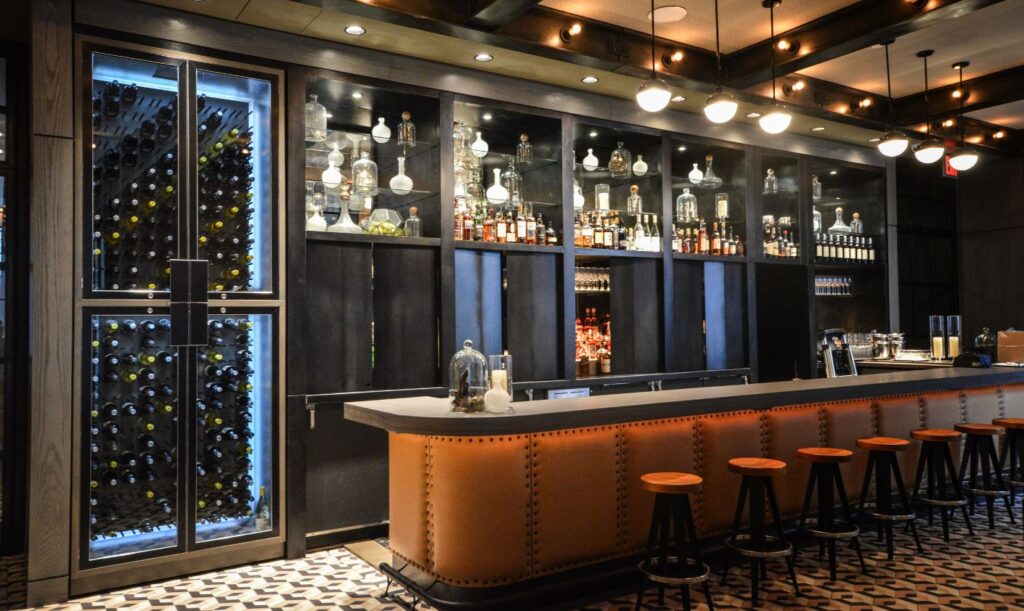
Wine Storage for Restaurants, Designed Around Service

Restaurant wine storage has a harder job than any cellar in a home. The door opens dozens of times a night, the kitchen adds heat to the building, stock turns over every week, and the list is on show to every guest who walks in. Storage that ignores any of those realities costs a restaurant in spoiled bottles, slow service or a list nobody notices.

The best restaurant wine storage is designed from the service outward: where the bottles live, how staff reach them in the middle of a busy night, and what the guest sees on the way to the table. Get that order right and one installation protects the inventory, speeds up the floor and sells the list.

This guide covers seven designs we build for restaurants, bars, hotels and private clubs, how they compare, and how to plan a restaurant wine cellar around the way the room actually works. Our commercial wine cellars page shows the projects.

wine cellar restaurant - Genuwine Cellars

What Restaurant Wine Storage Has to Do

Restaurant wine storage has four jobs, and they come in this order.

Hold the wine in condition

Wine keeps best at 55 to 58 degrees Fahrenheit and 55 to 70 percent humidity, in the dark and without vibration. Heat swings and light age it quickly and invite oxidation. In a restaurant the cost shows up twice: in the bottle that has to be poured away, and in the guest who notices.

Survive service

The cellar door may open a hundred times on a Saturday night. Storage has to recover its temperature between trips, and the bottles staff reach for most need to sit closest to the floor.

Keep the inventory honest

Bin numbers that match the list, formats grouped logically, and racking open enough that a manager can count stock in minutes. A misplaced bottle is lost margin.

Sell the list

A collection guests can see is a list they order from. Presentation belongs in the storage brief from the start, not as a finish added afterwards.

Seven Restaurant Wine Storage Designs

Each design below with who it suits and the move that makes it work. Most restaurants combine two or three.

1. The Restaurant Wine Wall

A conditioned wall of bottles facing the dining room, set behind glass for storage or built as open display for the wines that will be poured soon. It turns the list into the room’s centrepiece and gives the sommelier a stage.

Best for: fine dining rooms, steakhouses, and any room with a long wall and a serious list.

The move: label-forward racking such as Label Link or the PEG System, lit from above, with large formats at eye level. Our wine walls page and the Brass Legacy Wall project show the range.

wine wall in restaurant

2. The Glass-Enclosed Cellar in the Dining Room

A walk-in cellar with glass walls in view of the tables, so guests see the collection and staff can walk in for a bottle without leaving the room.

Best for: restaurants whose wine program is part of the brand.

The move: insulated glass, a door that closes and seals itself between trips, and a cooling system sized for the glass and the door traffic rather than the room’s volume alone. Opus is our glass and aluminium system; our glass wine cellars page covers the engineering.

3. The Back-of-House Cellar for Capacity

A room built for volume and inventory control rather than display, close to service but out of the guest’s path.

Best for: large lists, reserve stock, and restaurants that buy by the case.

The move: dense, commercial-grade racking such as Echelon, bin numbers that match the list, and case storage for the wines that move fastest.

wine display ideas restaurant - Genuwine Cellars

4. Wine Lockers for Restaurants and Private Clubs

Individual climate-controlled lockers where regulars, members or VIP guests keep their own bottles on site, ready for their next visit.

Best for: private clubs, members’ dining rooms, and restaurants with a loyal following.

The move: lockers designed as a feature of the dining room, each with its own lock and nameplate. Our custom wine lockers page and the private club dining room project show the format.

restaurant wine display - Genuwine Cellars

5. The Private Tasting Room

A climate-controlled cellar paired with a table, where a sommelier can lead a flight for a private party or a wine club.

Best for: restaurants that sell events, pairings and tastings.

The move: keep the cellar and the seating at separate temperatures with glass between them, and specify quiet cooling equipment so conversation carries.

6. Back-Bar and By-the-Glass Storage

Service refrigeration and short-term racking at the bar and the pass, holding tonight’s wines at serving temperature.

Best for: every restaurant with a by-the-glass program.

The move: separate zones for sparkling, whites and reds, and a back bar finished to match the main display so the bar reads as part of the collection.

Private club wine walls restaurant - Genuwine Cellars

7. Racks for Small Rooms

Wall-mounted racks, a compact wine wall or a freestanding display where there is no room for a cellar.

Best for: bistros, wine bars and intimate dining rooms.

The move: wall-mounted, label-forward racking such as Lumina on cable or the PEG System, holding only what will sell this week, with the rest kept in a conditioned space elsewhere.

Restaurant Wine Storage Compared

The seven designs side by side. Service speed is how quickly staff can reach a bottle during a busy night.

DesignBest forCapacityGuest visibilityService speed
Restaurant wine wallFine dining, steakhousesMediumHighHigh
Glass-enclosed dining room cellarWine-led restaurantsHighHighMedium
Back-of-house cellarLarge lists, reserve stockVery highNoneMedium
Wine lockersPrivate clubs, regularsMediumHighMember access
Private tasting roomEvents, wine clubsMediumBooked guestsLow
Back bar and by the glassBy-the-glass programsLowHighVery high
Racks for small roomsBistros, wine barsLowHighHigh

The usual combination is a wall or glass cellar for the list, a back-of-house room for depth, and a back bar for the glass pour.

Restaurant Wine Cellar Design, Planned Around Service

A restaurant wine cellar is designed for a different kind of day than a home cellar. Six decisions shape it.

Door traffic

Every opening lets warm air in. Self-closing doors, tight seals and a cooling system sized for a busy night keep the room stable between trips. An undersized unit runs through the whole service and still loses.

Kitchen heat

Keep the cellar off the kitchen wall, or insulate for it. Heat from ovens and dishwashers is a constant load the cooling system has to carry.

Temperature zones

Reds held for storage, whites and sparkling kept colder for service. Separate zones, or separate rooms, mean the wine is ready to pour without a detour through an ice bucket.

Layout and bin numbers

The wines staff reach for most sit nearest the door, grouped the way the list is written. Bin numbers that match the list make retrieval and stock counts quick.

Lighting

Cool LED only, dimmable, on a scene that suits the dining room at night. Halogen heat and daylight UV both shorten a wine’s life. Our wine cellar lighting guide covers the specification.

Equipment noise

Compressors belong outside the dining room. Ducted or split systems keep the equipment out of earshot of the tables.

Our design and installation guide covers the envelope and cooling in more depth.

Restaurant Wine Displays That Sell the List

restaurant-wine-display-Genuwine-Cellars.jpg

A restaurant wine display earns its space when it helps a guest order. Four principles we design to.

Show labels, not corks

Label-forward racking lets guests read the list on the wall and ask about a bottle they can see. It turns the display into part of the conversation at the table.

Feature the large formats

Magnums and larger bottles at eye level give the display a focal point, and they prompt the question that leads to a bottle.

Light for the room at night

Display lighting has to work at dinner light levels: warm enough to suit the room, bright enough to read a label, and cool enough to protect the wine.

Put it where guests pass

The entrance, the route to the tables or the wall behind the bar. A display that can only be seen from one table works for one table.

Restaurant Wine Storage by Venue

hotel wine cellar new york - Genuwine Cellars

Steakhouses

Big reds, large formats and a list built on vintage depth. A glass wall of the headline wines with a back-of-house room for reserve stock is the classic pairing.

Fine dining

A sommelier-led program wants a cellar guests can see, a tasting room for pairings, and precise zones for service temperature.

Wine bars

The list turns over quickly. Compact label-forward walls, a strong back bar and a small conditioned room for depth.

Hotels

Several outlets draw on one collection. A central cellar, with service storage at each restaurant and bar, keeps the inventory in one place and the list consistent.

Private clubs

Member lockers, a club cellar and often a humidor room alongside. Our humidor rooms page and the private club cellar project cover both.

Every restaurant project is scoped around the room and the list; our cost guide explains what drives the range.

Begin Your Masterpiece

Tell us about your collection and the room, and our wine cellar specialists will take it from there.

FAQs About Restaurant Wine Storage

How should restaurants store wine for daily service?

Keep the collection at a stable 55 to 58°F, away from vibration and light, and pair that cellar with service refrigeration near the floor for the wines that open tonight. Easy staff access matters as much as ideal conditions.

What is the best restaurant wine storage for a small space?

Wall-mounted racks, a compact wine wall or wine lockers. Each gives strong visual impact without a dedicated room; keep only what will sell this week on display and the rest in a conditioned space.

Can restaurant wine storage double as a design feature?

Yes. Wine walls, cable-mounted displays and glass-enclosed cellars are often placed in the dining room to be its centrepiece while still meeting proper storage conditions.

How much does custom restaurant wine storage cost?

It depends on capacity, materials and whether the project is a rack system or a fully engineered, climate-controlled cellar. Most restaurant projects are scoped after a walkthrough of the space and a review of the list and its growth.

What temperature should a restaurant wine cellar be?

55 to 58°F with 55 to 70 percent humidity for storage. Sparkling and whites are served colder and full-bodied reds slightly warmer, which is why many restaurants add separate service zones.

What is a restaurant wine wall?

A wall of wine facing the dining room, conditioned behind glass or built as open display for wines served soon. It stores part of the list and presents it to guests at the same time.

Do restaurants need wine lockers?

Not every restaurant, but for private clubs and restaurants with loyal regulars, climate-controlled lockers build loyalty and bring members back, and they work as a design feature in the room.

How big should a restaurant wine cellar be?

Big enough for the full list plus reserve stock and room to grow. We size cellars from the list, the buying pattern and the service flow, and can phase the build so it expands with the program.