

Begin with a quiet invitation: Imagine a room that holds time. A place where temperature barely stirs, where humidity rests like a silk veil, where every label glows as if lit from within. This is not a closet with shelves. This is a custom wine cellar, designed as an instrument to protect memory, terroir, and the ritual of opening something extraordinary. If you have felt the tug to create such a room, this guide is your map. It translates architecture and engineering into choices, reveals where the magic actually lives, and shows you how an idea becomes a sealed, living environment that will patiently shepherd your collection for decades.
We speak plainly about what matters: The envelope that makes calm possible, the cooling that carries the load without intruding, and the doors and glass that guard the boundary between your everyday climate and your cellar’s hush. We balance that clarity with romance because wine is not only chemistry and control; it is story and hospitality and light touching glass. Expect frameworks you can act on, and scenes you can inhabit. The goal is not a room that merely looks expensive. The goal is a room that behaves beautifully and feels inevitable.
Why trust this map? Because the patterns here are distilled from thousands of commissions, private sanctuaries hidden behind paneled walls, crystalline galleries that float at the edge of dining rooms, and high-capacity commercial spaces that perform under the theater of service. We have seen what fails, and more importantly, what lasts. Allow us to unspool the thread from vision to detail, from sketch to first pour.
What Is A Custom Wine Cellar?

Call it an ecosystem with one purpose: Serenity. A custom wine cellar is a sealed, climate-controlled environment tuned to the slow music of aging about 55°F in the cool, with humidity held in the 50-70% band, and variance so slight it feels like a heartbeat at rest. To reach that stillness, the room must act as a whole:
Envelope
Unbroken insulation, a warm-side vapor barrier, and an air-seal so meticulous that temperature hardly knows the seasons are changing.
Cooling
Equipment selected by load, not by hope, distributing air as a whisper rather than a gust, draining condensate like a stream you never see.
Openings
Doors with insulated cores and thermally broken frames, low-iron insulated glass that renders color truthfully, seals that close with a hush rather than a slam.

Storage
Geometry that matches how you live with wine – density where you need capacity, and label-forward where you crave clarity and speed.
Lighting
High-CRI LEDs that coax nuance from glass and paper without burdening them with heat or UV.
Controls
Sensors placed in real room air, not in the draft, logging conditions like a quiet scribe and alerting you only when action is needed.
When one part weakens, the spell breaks. Oversized equipment short-cycles and shivers; a cheap sweep leaks and invites the outside world in; a sensor reads the supply air and reassures you falsely. But, when the parts align, time slows. The bottles rest. You exhale.
A brief tale to anchor this: A jewel-box glass room seemed to wander two degrees every afternoon. The solution was not “more power.” It was a new threshold detail, a truer gasket, and relocating a sensor out of the conditioned breeze. Stability returned almost at once. Luxury is often precision masquerading as ease.
Custom Wine Cellar Design Styles
Design Styles: Aesthetic Language & Engineered Calm
Design is the story your cellar tells before a bottle is ever opened. Choose the language that feels like you, then insist on the same bones of performance behind any expression.

Traditional Wine Cellars
Think of a hush you can touch: Walnut and white oak with a satin hand, arches that frame perspective, and paneled walls that seem to have always been there. Diamond bins cradle cases like parcels of winter. Cubbies hold 750s in quiet ranks. Magnum bays wait like bass notes in a string quartet. Warm-dim light settles into coves and falls in soft ellipses across labels.
This style favors homes with history or rooms that want to feel like a library. The craft is not merely visible; it is audible, the reduction of echo, the soft resistance in a well-made drawer, and the weight of a door that closes with a promise. Finish systems are chosen to remain poised at cellar temperatures. Wood enters the room at 6-8% moisture and swells or shrinks so little that seams stay elegant. The effect is a private club in miniature, except it belongs to you.

Modern & Minimalist Wine Cellars
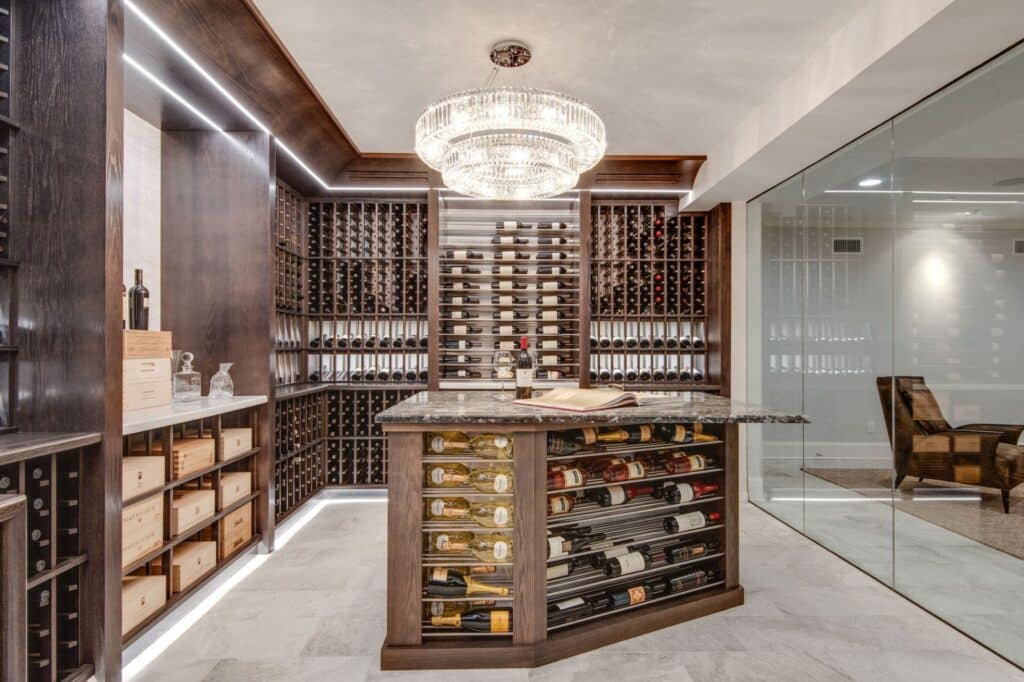
Now, a different spell: Shadow lines and perfect planes. Low-iron glass so clear it disappears. Metal systems that cradle each bottle from beneath, or cables that let labels float like pages in a book. The room recedes; the collection speaks. Every misalignment would shout, so tolerances tighten. Frames gain thermal breaks you never see, gaskets catch with magnetic certainty, and multi-point latches keep tall doors faithful in storms of air pressure.
Lighting grazes surfaces and reveals texture without glare. Back panels darken to deepen the sense of space, then recede from sight to give the bottles stage. It is restraint, yes, but not coldness. The warmth arrives in the glow, the slow breath of the equipment hidden beyond, the absolute clarity of glass showing precisely what you own.
Glass-Enclosed Wine Rooms
Here, the boundary is the theater. The room is not a separate world; it is a luminous chamber inside your living space. To make the illusion work without sacrificing performance, the glass becomes architecture: Insulated panels, perfectly sealed perimeters, thresholds that arrest air wash, and hardware that answers height and weight without drama. Insist on the invisible virtues; U-value, gaskets, latching – before you chase the last measure of optical purity. The alchemy is that guests will feel mystery yet sense nothing mechanical.

Spiral Wine Cellars
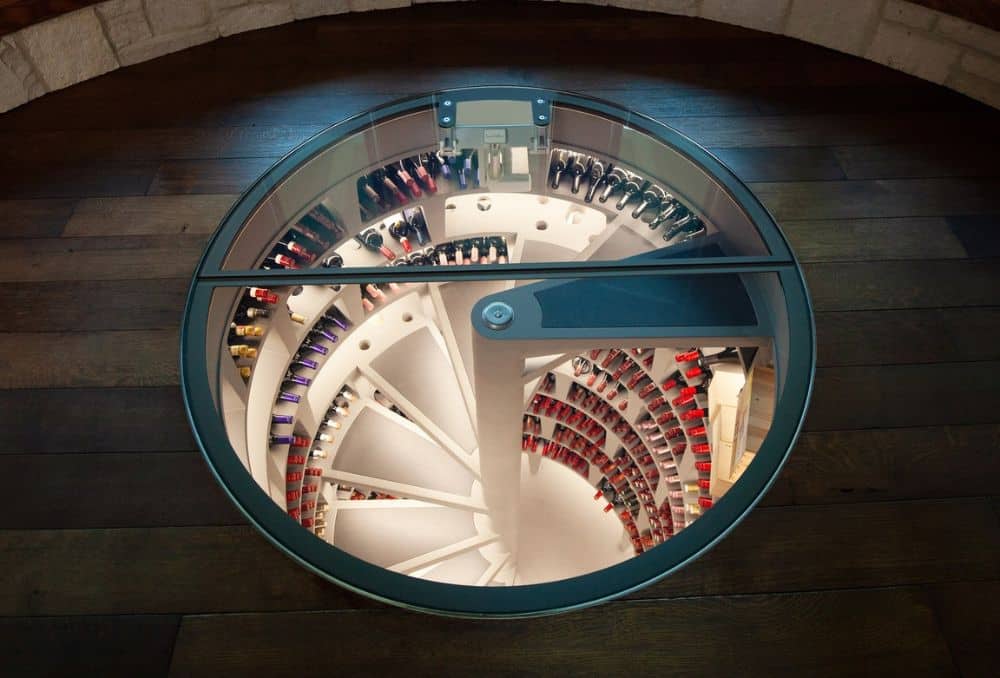
When space is precious or you crave a hidden portal, a spiral cellar is a poem cast in concrete and light. A circular opening lifts like a ritual object, revealing shelves that descend into quiet. Treads invite you to turn inwards. The capacity in so small a footprint feels like a magician’s reveal. But behind the wonder are the same disciplines: Structural openings prepared like surgery, seals at the lid, drainage that never calls attention to itself, and lighting that guides without glare. It is a secret kept politely, a chamber beneath your feet that lets your main room breathe freely.

Under-Stair & Compact Wine Solutions
Sometimes the best stories arise from the spaces architecture leaves behind. The underside of a stair becomes a gallery. A slender wall becomes a vertical library that glows in the evening. Reduced-depth racks keep corridors generous; remote equipment hums elsewhere; lighting follows the slope of the stair, stepping the eye along as gracefully as a waltz. These rooms are proof that intimacy, not scale, is the measure of luxury.
Planning Your Custom Wine Cellar
The art is to make decisive choices early so that later phases feel inevitable.

Choosing The Right Location
Score each candidate space. Which stays calm in summer’s insistence and winter’s austerity? Which allows clean routes for power, drain, and lineset or ducts? Which carries the load of glass and racking, and which places the cellar close enough to your kitchen or dining room that service feels like a short reach rather than a trek? Finally, which can be isolated from vibration? If two options tie, choose the one that shortens the journey from selection to table. Convenience is a sub-species of pleasure.
Storage Capacity & Growth Planning
Design for your future self. Count what you own, then honor the shape of your habit, acquisitions across five years, the ratio of everyday bottles to patient ones, the need for cases and large formats.
A practical guide lives here: label-forward metal systems reach roughly 10–12 bottles per square foot of racking face; traditional cubbies sit closer to 8–10; case bins sacrifice visibility to maximize density. Keep the “pour now” zone near eye and arm reach. Reserve lower bays for cases and upper shelves for long sleep. Above a thousand bottles, a discreet barcode layer lets your memory breathe.
Budget & Timeline Considerations
Money is not a mood; it is a map. The first treasure you protect is the envelope. A tight, properly detailed shell makes everything gentler: smaller equipment, less noise, lower energy, longer life. After that, the next best investment is the door and glass that hold the boundary. Then the equipment sized to the truth of your load. Then the racking and hardware that will serve your hand for years. Finally, the lighting and controls that give emotion and scene.
Timelines stretch where custom glass waits for perfect edges, where millwork insists on patience, where inspections require choreography. Approvals on shop drawings move time like a lever. Decide with care, then do not un-decide.
Wine Organization & Cataloging
Order is a kind of hospitality. Organize by drinking window within region or variety. Label zones; let your future self find what present you stored without breaking concentration. Keep a quarantine shelf to hold the occasional leaker, protecting the row beneath like an awning protects a passerby in rain. Your cellar may be a sanctuary, but it is also a workplace serving a loyal patron your taste.
Electrical And Lighting Installations
Electrical Load Planning For Cooling Units & Lighting
Cooling equipment often mandates dedicated circuits and specific amperage; some manufacturers warn against GFCI on compressor loads. Coordinate early with electrical to prevent nuisance trips and voltage drop on long runs.
Dedicated Circuits & GFCI Outlets
Under the 2020-2023 NEC, GFCI coverage expanded, including basements and up to 250 V receptacles in specified locations. Check with your AHJ; you may need GFCI on general receptacles while keeping dedicated hardwired cooling on its own non-GFCI branch as allowed by the manufacturer and code.
LED Vs. Halogen Lighting Considerations
LEDs offer negligible UV and lower IR compared with legacy sources, critical to avoid light strike and heat near bottles. Use high-CRI LEDs and dim to taste; reserve halogen for non-cellar zones. The Canadian Conservation Institute provides selection criteria for “excellent” LED sources in collection spaces.
Lighting Placement For Safety & Aesthetics
Aim to graze labels, not corks. Shield sources to avoid glare on glass. Backlight onyx or resin features with diffused, low-wattage strips, and interlock lighting with door contacts or occupancy to reduce exposure time.
Smart Controls & Sensors Integration
Most professional platforms support wall controllers, remote sensors, and alarms. Wireless is convenient; wired is more reliable. Integrate leak detectors and door sensors into the same ecosystem.
Door And Glazing Specifications
Glass Vs. Solid Doors R-Value Requirements
There’s no one “required” R-value; the right answer is a balanced heat-load calculation that includes the door’s U-factor. As a rule, more glass means higher cooling capacity and tighter lighting discipline. Use laminated, low-iron glass with UV-screening interlayers where daylight or bright display lighting is present; standard PVB interlayers screen >99% of UV below ~380 nm, with specialty interlayers extending protection to 400 nm.
Double-Pane Or Low-E Glass Options
Typical double-pane low-E units range roughly from U-0.20-0.40 (whole window), translating to about R-2.5-R-5 depending on makeup. Frame, spacers, and installation drive the true assembly U-factor; don’t quote center-of-glass values as whole-door performance.
Thermally Insulated Wine Cellar Doors
A solid insulated door typically delivers R-5 to R-6 performance; solid wood is closer to R-2-R-4. If you want glass, compensate elsewhere in the envelope or in the HVAC capacity.
Sealing & Threshold Details
Frameless glass can work if you treat it like a museum case: Perimeter weatherstrips, door sweeps or automatic bottoms, and continuous thresholds to limit infiltration. Hardware houses supply brush and bulb weatherstrip kits for all-glass doors; use them.

Racking, Shelving, And Finishing Touches
Material Types
Review the material matrix here for quick comparisons of wood, metal, glass, and composite options by style and environment: Use corrosion-resistant fasteners, and keep ferrous components away from damp zones without a protective finish.
Installation Techniques & Load-Bearing Tips
Anchor into framing or engineered blocking. For floating and cable systems, verify substrate capacity and use manufacturer-rated anchors and tensioners. For high-density walls, plan blocking at layout, not after drywall.
Mounting To Studs Or Wall Systems
Bottle-forward and peg systems load the wall differently than cubbies. Continuous plywood backing behind gypsum (or metal studs with hat channels and plates) simplifies anchor placement while keeping surfaces flush.
Custom Finishes & Protective Coatings
Low-VOC, water-borne polyurethanes and conversion varnishes reduce odor risk in closed rooms. Metalwork benefits from powder coats or clear coats over brass/bronze to control patina in humid air.
Integration With Tasting Tables Or Display Zones
Treat tasting ledges and tables as thermal and airflow objects. Avoid obstructing supply/return paths, and isolate any heat-emitting elements (audio, displays) from bottle zones.
Building Codes, Permits, And Compliance

Local Permit Requirements For Residential Vs. Commercial Cellars
Permits are jurisdictional. Expect review of structural changes, electrical circuits, mechanical equipment, glazing, and egress. Commercial programs add accessibility and life-safety layers. Document the envelope (insulation R-values, air/vapor strategy) and mechanical schedules in the submittal set.
Moisture & Electrical Code Considerations
Inspectors scrutinize vapor control in below-grade work and GFCI locations. Recent NEC cycles expanded GFCI coverage, including basements and higher-voltage receptacles in specified locations; coordinate dedicated, non-GFCI hardwired branches for equipment if permitted and required by the manufacturer.

Fire-Safety, Ventilation, & Access Regulations
Use listed materials where fire ratings are required. Don’t vent condensers into small mechanical closets; exhaust outdoors or into adequately sized spaces per the manual. Maintain clearances around equipment and safe access for service.
Working With Inspectors & Contractors
Bring manufacturer manuals to inspections. Demonstrate that your drain, electrical, and air paths match documentation. The fastest approvals come from clean detailing and clear documentation.
Hiring The Right Wine Cellar Contractor
What To Look For In A Specialist Builder
You want a crafter fluent in building science, refrigeration, and millwork. Ask for projects with laminated UV-screening glass, ducted split systems, and complex racking. Verify they own a thermal camera and hygrometers and can explain their vapor strategy. Contact Genuwine Cellars to discuss your project.
Contact Us
"*" indicates required fields
Key Questions To Ask Before Hiring
Use this checklist.
Understanding Warranties & Post-Installation Support
Look for warranty coverage on the envelope, equipment, and racking, plus a documented maintenance path: filter cleaning, drain inspection, and controller updates.
Frequently Asked Questions About Wine Cellar Construction
What type of insulation should be used in a wine cellar?
Closed-cell spray foam for air-impermeable layers at rim joists and as a controlled vapor retarder where appropriate; rigid foam continuously against concrete; unfaced batts only when the cold side is isolated by an air-impermeable layer. Continuity and correct vapor placement matter more than brand.
Where should the vapor barrier be placed in a wine cellar wall assembly?
There’s no universal plastic-on-the-inside rule. In basements, insulate the concrete with continuous rigid foam and avoid interior polyethylene so the wall can dry inward. In BSC’s wine-cellar floor detail, avoid a waterproof membrane directly above sub-slab foam to prevent a seasonal double vapor barrier.
What R-value is recommended for wine cellar insulation?
Walls commonly target R-19 and ceilings R-30 in practice, but the critical piece is continuous insulation and air sealing around the entire envelope. Sub-slab rigid foam improves comfort and reduces condensation risk. Always reconcile target R-values with the heat-load calculation.
Do I need a separate HVAC system for my wine cellar?
Yes. Condition the cellar independently. Wine cooling units are designed for low-temp, moderate RH setpoints, with proper condensate management and dedicated circuits. Split and ducted systems move noise and heat away from the room.
How do I prevent condensation inside a wine cellar?
Get the envelope right: Continuous air barrier, correct vapor control, and appropriate insulation. Seal door perimeters and thresholds, specify laminated UV-screening glass where daylight is present, and manage condensate with pitched, trapped drains. Keep lighting low-heat and low-UV.
What flooring materials are best for wine cellars?
Natural stone and porcelain are the lowest-risk. Engineered wood works with tight humidity control and a proper sub-slab vapor barrier.
Can a wine cellar be built on an exterior wall?
Yes, but expect higher heat loads and more rigorous detailing. Increase continuous insulation at that face, select better glazing if using glass, and size the cooling system accordingly. “More glass = more load” is a reliable planning heuristic.
How do you calculate cooling load for a wine cellar?
Use a heat-load calculator that accounts for volume, surface assemblies, insulation, air leakage, glass, lighting, and usage. Never size on cubic footage alone. Compare outputs with major manufacturers’ calculators for a sanity check.