

If your collection matters, innovation isn’t optional. The goal isn’t novelty for its own sake; it’s tighter environmental control, better bottle access and display, and materials that age beautifully under cellar conditions. By the end of this guide, you’ll have a clear view of the systems, structures, and technologies defining next-generation cellars: Label-forward racking, floating and cable assemblies, smart lighting, advanced glazing, anti-vibration strategies, moisture management, and sustainability moves that don’t compromise luxury.
Our perspective is grounded in designing and engineering climate-controlled cellars for private residences, hospitality, and commercial spaces. We prioritize solutions backed by building-science principles, conservation-grade lighting practice, glazing science, and measurable performance under 10-15 °C with 50-70% relative humidity.
Why Innovation Matters In Wine Cellar Design
Wine is sensitive to temperature swings, UV and short-wave visible light, and vibration. Precision control extends lifespan and protects value; design innovation makes that control seamless. Laminated glass with UV-screening interlayers protects labels and juice chemistry in glass-forward rooms. Modern LEDs minimize UV/IR, allowing dramatic display without heat load. Vibration isolation preserves aging trajectories that can be measurably altered by chronic micro-vibrations. These are not theoretical refinements; they’re evidenced in materials science, conservation practice, and oenological research. Saflex and Vanceva Canada
Modern Wine Cellar Features
Modern cellars lean on precision machining and minimal hardware to let labels read cleanly at a glance while keeping airflow unobstructed for even conditioning. The following proprietary systems exemplify the shift from bulky grids to sculptural, high-function displays:

The PEG System
PEG-based systems decouple bottle support from full-height racks. The benefit is twofold: A label-forward presentation with negative space and fewer dust ledges, and more continuous air circulation across bottles and walls for stable temperature/humidity stratification. When used on insulated back panels, pegs also keep bottles off potentially cooler exterior surfaces, reducing condensation risks where envelopes aren’t perfect. For compliance in commercial installs, confirm local rack anchorage and egress clearances; general rack safety guidance treats these as structural storage elements. Ontario

The Curve & Q-Curve
Curvilinear cradles distribute load along the bottle, eliminating point pressure at labels and foils. The geometry reads as sculpture, but it’s pragmatic too: Smooth insertion and retrieval, consistent pitch for sediment stability, and clear sightlines. Pairing with laminated low-iron glass maintains color fidelity of labels and reduces green cast in bright spaces. Architectural Glass and Metal

The Cube Modern
Modular cubicles allow mixed orientations in one grid, neck-out for fast inventory, label-forward for feature rows. In glass-fronted rooms, use low-iron laminated lites to avoid color shifting, and specify soft-close hardware to prevent micro-shocks when doors seal. Architectural Glass and Metal

Label Ladder & Label Link
Linear, ultra-thin supports create a gallery-wall effect with minimal visual mass. The engineering intent is fixed spacing, consistent reveal, and easy cleaning in high-visibility spaces. Integrate with tunable-white LED grazers to keep luminance on labels and off corks and capsules. Tunable systems shift correlated color temperature for rendering and ambience without introducing damaging UV. Canada
Floating And Cable Wine Systems
Suspended systems unlock transparency. Properly designed, they carry significant bottle loads with virtually no visual bulk:
The Ring
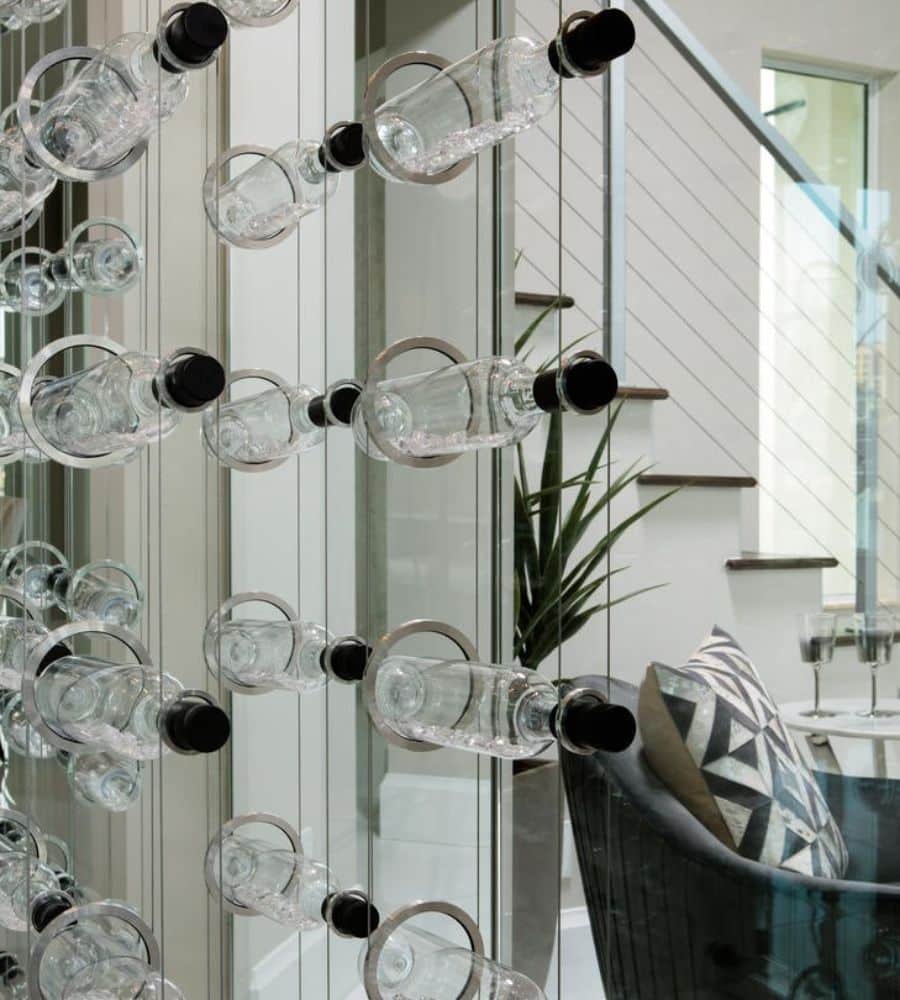
Annular supports register each bottle consistently and frame labels. The structural advantage is a direct load path to ceiling and floor anchors with minimal intermediate framing. Confirm substrate capacity and embed plates where required; isolation washers can decouple fixtures from minor structural vibrations. For reference, specialty cable systems are engineered around stainless tension members, anchors, and code-compliant clearances.
Cable Wine Systems
Label Line

Parallel tensioned elements hold bottles in precise horizontal arrays. Visual effects aside, the open structure promotes even airflow and simplifies dust maintenance. Keep aisles clear of protrusions for safety per rack guidelines. Wine Cellar Depot
Lumina

Lighting integrated into suspension members turns racking into a luminous armature. Use conservation-grade LED strips with appropriate diffusers to avoid point-source glare and preserve label readability. LED systems emit negligible UV/IR relative to legacy sources, reducing both lightstrike risk and heat near bottles. Canada
Lighting Innovations
Lighting in a cellar is a preservation tool first, aesthetic second. The best programs treat labels as artifacts:
LED Backlighting
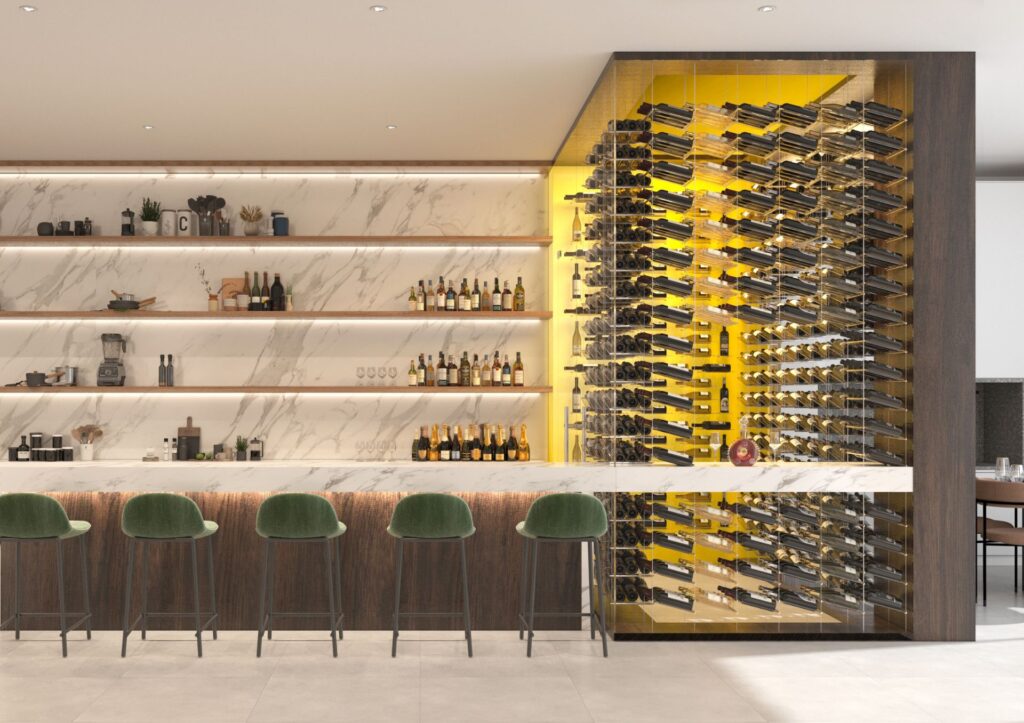
Backlighting stone, glass, or resin panels creates depth without radiating heat onto bottles. Choose LEDs vetted for conservation environments and dim to the minimum required for viewing. The Canadian Conservation Institute underscores that high-quality LEDs minimize damage risk when paired with proper exposure control.
Showcase Lighting
Low-glare, high-CRI accent luminaires render labels accurately at modest illuminance. Museum guidelines often target CRI ≥ 80-90 for true color rendering; you don’t need retail brightness to create drama. Coordinate beam angles to avoid veiling reflections on glass.
Smart Lighting Controls
Scenes, time-of-day dimming, and tunable white increase usability without increasing risk. Tunable systems blend warm and cool LED channels to match mood or event while maintaining low UV/IR output. Integrate with occupancy sensors so lights default off; the simplest way to reduce exposure is to reduce time lit.
Glass And Structural Innovations
Glass cellars are now centerpieces, but the glazing package must protect the collection:
Frameless glass enclosures.
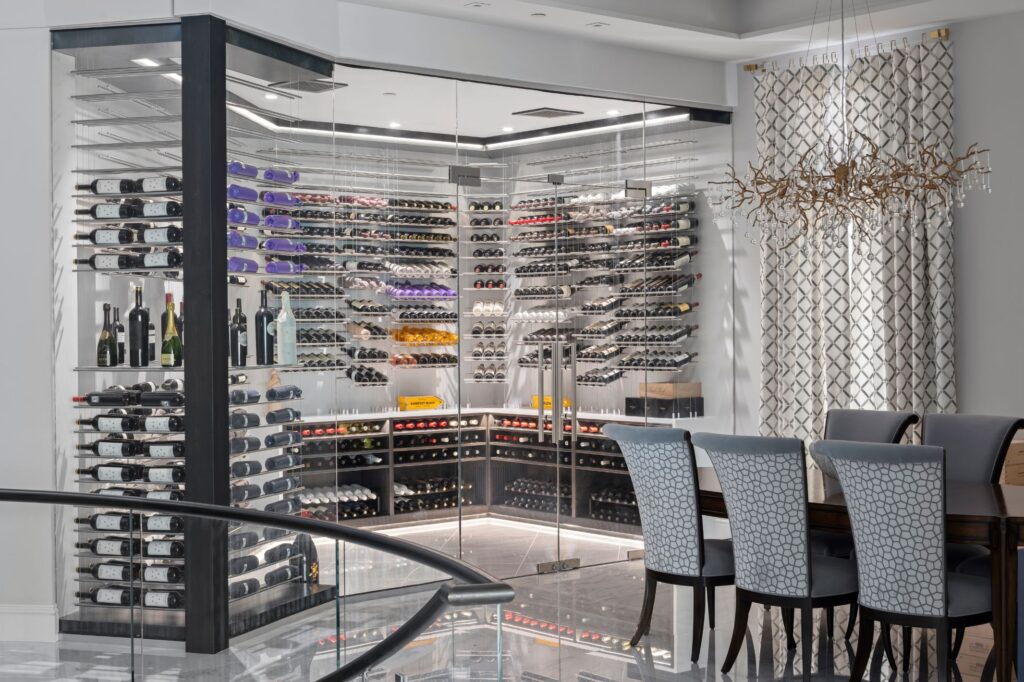
Heavy tempered or laminated glass allows panoramic views; frameless programs rely on precise hardware, door seals, and engineered tracks. Many fabricators offer low-iron options for clarity. Use climate-rated seals and continuous thresholds for integrity. All Glass Architectural Glass and Metal
UV-treated laminated glass.
Standard PVB interlayers screen about 99% of UV; specialty interlayers extend screening up to 400 nm, addressing the lightstrike band implicated in white wine degradation. This matters anywhere sunlight or strong display lighting can reach bottles. PNAS Saflex and Vanceva Qdel Laminating Supplies

Integrating water features and marble vaults.
Water and stone add gravitas, but both increase thermal mass and potential humidity load. Pair with robust vapor control and a cooling unit sized for latent as well as sensible loads. Protect sensitive finishes with proper sealing and detail for condensate management. Building Science Corporation’s cellar guidance shows how pressure and vapor drive shift with seasons; assemblies must be detailed accordingly.
Mixed materials.
Cross-disciplinary detailing, steel, wood, stone, and glass, demands attention to differential movement at low temperatures and higher humidity. Floating connections and thermal breaks at anchors reduce condensation and stress.

Smart Technology And Automation
The smartest cellars are quiet about it: Discreet sensors, alerts when anything drifts, and remote access for peace of mind:

Wi-Fi controllers and alerts.
Many wine-specific cooling platforms now ship with or accept Wi-Fi modules for app-level monitoring, setpoint changes, and event notifications. Useful for second homes or travel.
Remote sensors and multi-point averaging.
Distributed temperature/humidity sensors reduce hot- or cold-spot bias, feeding a controller that averages readings and alarms out-of-range conditions. Commercial systems support multiple remotes and remote interfaces for an at-a-glance status outside the room.
Ecosystem integration.
Smart lighting, leak detection, and door sensors tie into the same network. Consumer-grade devices can handle tunable white scenes and scheduling; professional-grade systems integrate with AV and security platforms.
Flooring And Structural Innovations
Two problems to solve: Movement (vibration) and moisture:

Anti-Vibration Flooring
Persistent micro-vibration can accelerate certain chemical shifts and disturb sediment, with measurable impacts reported in peer-reviewed studies. Isolation starts at the floor: Floating floor systems with resilient mounts, tuned to shift the system’s natural frequency below excitation frequencies, dramatically reduce transmission from structure or adjacent mechanicals. Where structure-borne vibration is a concern, consult building-vibration isolation guidance to select elastomeric pads or spring isolators with the right deflection.
Kinetics Noise

Integrated Drainage & Moisture Barriers
Cellars live in a humid setpoint range. Misplaced vapor barriers trap moisture and rot assemblies; correct placement depends on climate and assembly type. Building-science references show how vapor flow reverses seasonally and why cellars need continuous air/vapor control and careful floor build-ups. If over slab, include a capillary break and vapor barrier beneath, with finishes above that tolerate humidity and occasional spills. When using conventional insulation, some manufacturers recommend the vapor retarder on the warm side of insulation; always reconcile manufacturer guidance with climate-specific building-science recommendations.
Building Science
Sustainable Wine Cellar Design
Sustainability in a luxury cellar means responsible materials and lower operational loads, without compromising performance:

Certified wood.
FSC-certified timber verifies responsible forest management and is widely available in solid and engineered forms suitable for cabinetry and racking.
Low-VOC finishes and adhesives.
Specify coatings and adhesives that meet LEED low-emitting criteria based on the CDPH Standard Method. This reduces indoor emissions during and after installation.
High-efficiency conditioning.
Heat and energy-recovery ventilators help manage fresh air requirements with reduced energy penalty, especially in larger hospitality spaces adjacent to cellars. Selection should consider whether sensible-only or total enthalpy exchange is appropriate for your climate.
Lighting load reduction.
LEDs cut energy, heat, and maintenance while protecting contents. Pair with controls to minimize run-time.
FAQs About Wine Cellar Innovations
What are the latest innovations in custom wine cellar design?
Label-forward peg and ladder systems; floating/cable racking; conservation-grade LED lighting with tunable white; laminated, low-iron, UV-screening glass; anti-vibration floor assemblies; multi-point sensing with Wi-Fi alerts; and envelope detailing informed by building science. Building Science
How do floating wine racks work?
How do floating wine racks work?
They use tensioned stainless cables or concealed armatures anchored into the structure at floor and ceiling, or wall substrates. Loads transfer through engineered anchors; open spacing supports airflow and label visibility. Follow manufacturer parameters for bottle types and anchorage; keep aisles clear per rack safety guidance. Wine Cellar Depo
What is the benefit of UV-treated glass in wine cellars?
UV and short-wave visible light can trigger “lightstrike,” altering aromas in days for some white wines. Laminated glass with PVB interlayers screens ~99% of UV, with specialty interlayers extending screening up to 400 nm. Combine with LEDs to minimize UV/IR exposure. PNAS & PMC
Are modern wine cellar innovations more expensive than traditional ones?
Some are, but they often lower lifecycle costs and risk. LEDs cut energy and maintenance; remote monitoring can prevent loss events; engineered glazing protects labels; and optimized envelopes reduce HVAC load. Value isn’t just initial spend, it’s preservation and reduced failure rate. Canada
Can innovative systems like cable racks or smart tech work in small spaces?
Yes. Cable and peg systems excel in narrow rooms because their minimal mass preserves openness and airflow. Wi-Fi controllers, compact sensors, and tunable LED strips fit discreetly in tight footprints. Wine Guardian Dealer
What innovation has had the biggest impact on wine cellars in the last decade?
A tie between conservation-grade LED adoption and laminated UV-screening glass in display-oriented rooms. Together, they allow gallery-level presentations with minimal risk to wine chemistry and labels. Canada
Bringing Innovation Into Your Wine Cellar Project
Key moves that consistently elevate results:
- Commit to a label-forward system that fits your architecture: Pegs, Curve/Q-Curve, Cube Modern, or Label Ladder/Link.
- Use laminated, low-iron glass with UV-screening interlayers anywhere bottles are visible to daylight or bright display lighting.
- Design for silence and stillness: Isolate floors where needed; specify soft-close hardware; keep compressors mechanically decoupled from the room.
- Light like a museum: High-quality LED, tuned and dimmed; control exposure time; deliver high CRI without heat or UV.
- Instrument the space: Multi-point sensing, Wi-Fi alerts, and a controller that protects setpoints automatically.
- Detail the envelope: Get vapor control, insulation continuity, and moisture management right before you pick finishes.
For a deeper dive into planning, specification, and budgets, go to our Ultimate Guide to Custom Wine Cellars and start a design brief with our team.
Contact Us
"*" indicates required fields