

A serious cellar is equal parts architecture and preservation science. The right materials look exquisite, but they also stabilize temperature and humidity, protect labels and corks, and age bottles as intended. By the end of this guide, you’ll know exactly which woods, metals, glass types, stones, tiles, finishes, and accessories belong in a high-end, climate-controlled space, and why.
As a team that designs and crafts custom cellars, from private penthouses to hospitality projects, we shortlist materials not because they’re fashionable, but because they perform under 10-15℃ / 50-59℉ and 50-70% RH, with minimal light and vibration. That’s the envelope wines need to mature gracefully.
Why Materials And Finishes Matter In Wine Cellar Design
In a cellar, materials aren’t passive décor; they’re functional components of a controlled environment.

Dimensional stability
Woods and floors must tolerate cool temperatures and elevated humidity without cupping or gapping. Engineered substrates and species with proven stability reduce seasonal movement.

Moisture and vapor control
Stone, porcelain, and properly detailed vapor barriers resist moisture migration and protect adjacent assemblies. Flooring choices should accommodate a vapor barrier over slabs.
Light management
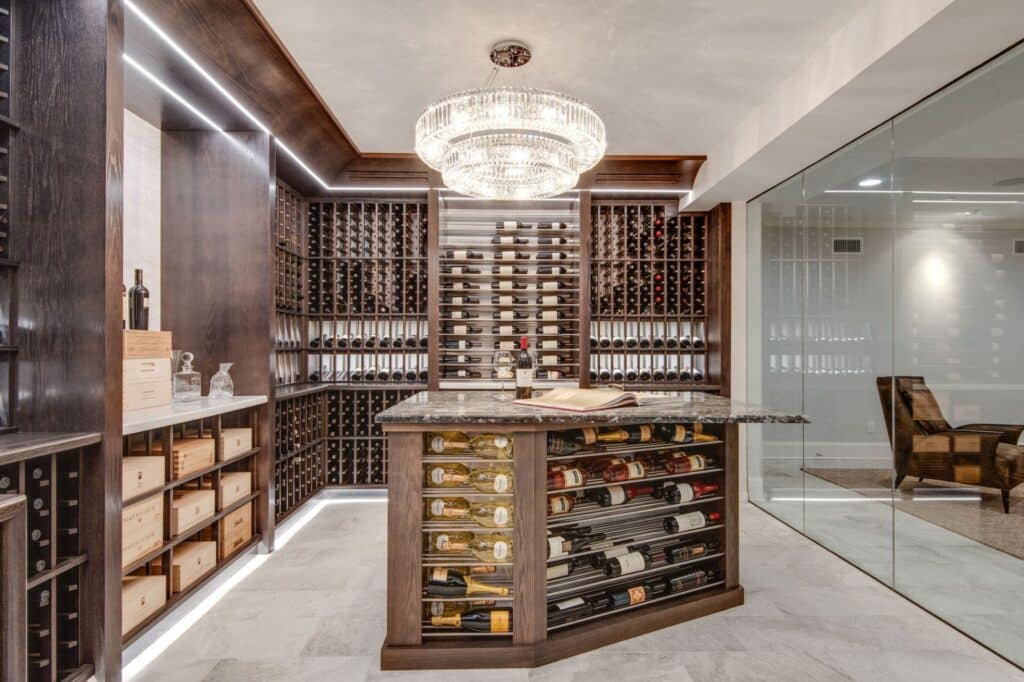
Glass, lighting, and finishes should minimize UV and heat to prevent light strike and premature aging. LED sources are the standard because their UV and IR output is negligible. For glass, UV-attenuating laminated makeups are ideal where daylight is present.
Think of your palette as an ecosystem: Each selection should support preservation first, then aesthetics.
Premium Woods For Wine Cellars
The best cellar timbers balance beauty, workability, and stability in cool, humid air. Finishes should be low-odor and low-VOC once cured.

Mahogany
African mahogany is a long-time cellar staple for its grain and finishing quality. It’s moderately durable, machines cleanly, and stains beautifully. In damp conditions, avoid iron fasteners that can react; stainless or brass is preferred.
Walnut
Black walnut brings a deep, refined palette and excellent dimensional stability compared to many temperate hardwoods, useful for precise joinery in displays and cabinetry. It also steam-bends well for curved features and coopered corners.

Oak
White oak’s closed pores (tyloses) make the heartwood relatively impermeable, one reason it’s used in tight cooperage and even boatcrafting. Expect high durability and a wide finishing range from cerused to fumed effects.
Reclaimed & Exotic Hardwoods
Reclaimed timbers add provenance and texture. Ensure they’re kiln-dried to kill insects, drive down moisture, and stabilize the stock before fabrication; request documentation from the supplier. Exotic species can be spectacular, but confirm responsible sourcing and check movement/finish behavior in humid rooms.
Internal inspiration: See our Traditional Wine Cellars portfolio for millwork detailing and finish standards.
Metal And Glass Accents
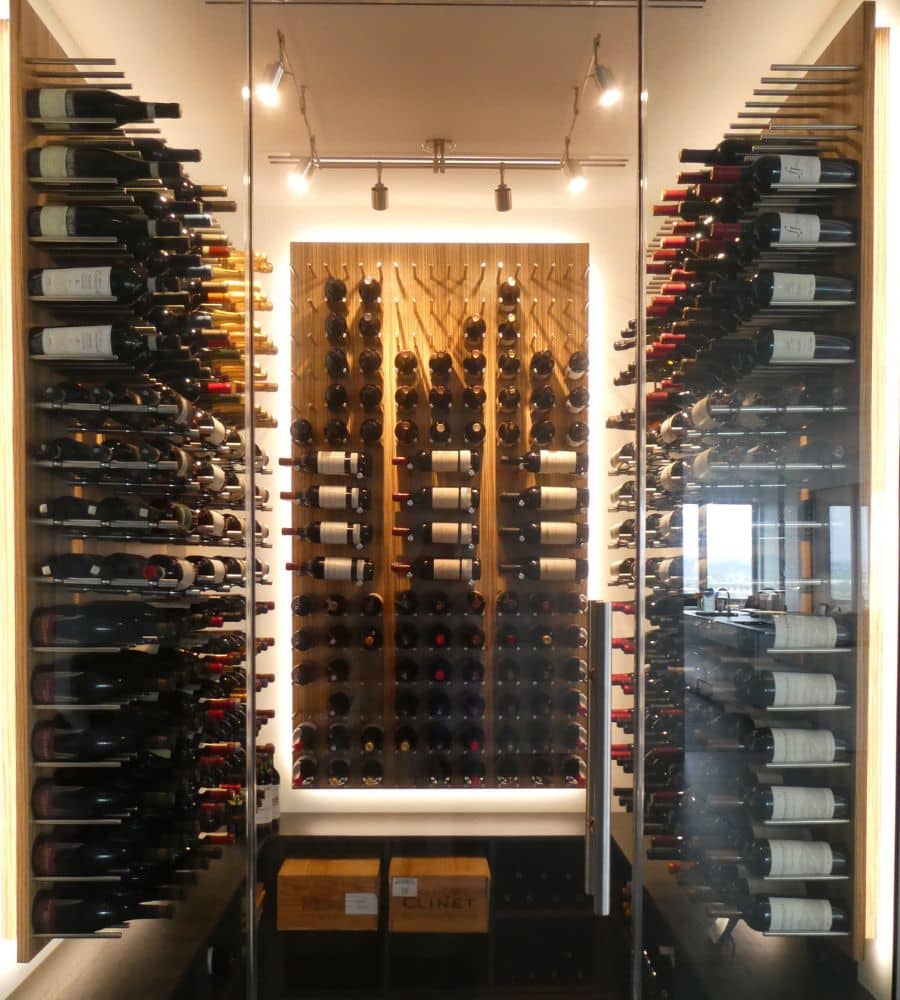
High-touch metals and optically clear glass modernize a cellar while serving technical roles around doors, frames, shelving, and label-forward systems.
Stainless Steel
Use 304 for most interiors; step up to 316 where chloride exposure or aggressive cleaners are expected, thanks to its molybdenum content and improved corrosion resistance. Satin and PVD finishes minimize fingerprints.
Bronze & Brass
Both patinate elegantly. Bronze is generally stronger and more corrosion-resistant, making it a smart pick for pulls, grills and trims in humid rooms; brass is excellent for purely decorative accents and warmer gold tones. Expect natural darkening; specify pre-patinated or clear-coated where you want to lock the look.
Tempered Glass
For doors and enclosures, tempered glass provides safety and strength, roughly four to five times stronger than annealed and is designed to crumble into blunt pieces if broken. For spaces with daylight, laminated low-iron glass with UV-blocking interlayers keeps labels and wine protected while maintaining color accuracy and clarity.
See examples in our Glass-Enclosed Wine Rooms gallery.
Stone, Tile, And Flooring Options
Floors do heavy lifting in a cellar: They need to tolerate humidity, carry thermal mass, and shrug off the occasional spill.
Natural Stone & Marble
Stone is durable, moisture-tolerant, and offers thermal mass; it absorbs and slowly releases heat, contributing to temperature stability when the envelope is properly insulated. Marble is luxurious but porous and prone to etching; seal appropriately and plan for maintenance. Concrete Centre+2Building.govt.nz
Tile & Ceramic Finishes
Porcelain is denser than ceramic and typically has ≤0.5% water absorption, making it ideal for humid rooms. For floors, watch PEI wear ratings (III-V, depending on traffic) and COF for slip resistance. Large-format porcelain can deliver a monolithic look with minimal grout.
Engineered Flooring
If you want a wood look under cellar conditions, engineered planks outperform solids because of their cross-laminated cores. Still, keep humidity tight to avoid gapping, and use a robust water-based finish to minimize VOC load after cure. Always incorporate a vapor barrier over concrete.
Looking for stone-rich statements? Browse our portfolio case studies.
Finishing Touches And Decorative Elements
Details make the room, and they must respect the climate envelope.
Custom Cabinetry & Racking Finishes
Water-borne polyurethanes and modern low-VOC systems dramatically reduce off-gassing versus traditional solvent finishes while delivering excellent clarity and durability. Oils and waxes are lower-sheen options but typically require more upkeep.
Decorative Ceilings & Beams
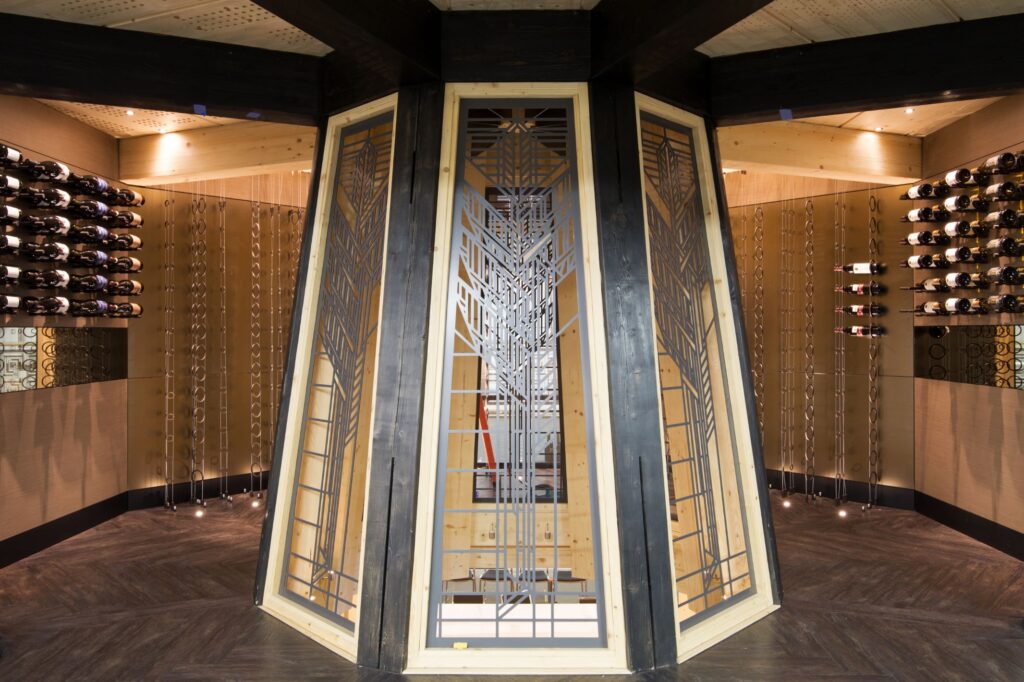
Clad ceilings in stable timbers or stone panels to amplify the acoustic hush and visual gravitas. In glass rooms, consider bronze or blackened steel beams as rhythm lines that frame views without compromising sightlines to labels.
Luxury Hardware & Accessories
Specify solid bronze or stainless for longevity in humid rooms, with magnetic catches, soft-close slides, and museum-grade shelf pins. Integrate UV-safe LED display lighting and dimmable ambient strips for drama without heat.
Explore finished spaces with coffered ceilings, metalwork and bespoke cabinetry in our Decorative Elements project portfolio.
Choosing The Right Materials For Your Vision
Match architecture to intent:
Traditional Custom Wine Cellar Materials
Mahogany or white oak millwork, solid bronze hardware, coffered ceilings, and limestone or marble floors. Warm 2700-3000 K LEDs, dimmed low.

Transitional Cellar Materials
Walnut cabinetry with low-sheen water-borne finishes, brushed stainless labels, porcelain slabs that mimic stone, and a framed glass entry with laminated, low-iron lites.

Modern Wine Cellar Materials
Ultra-clear laminated glass enclosures, powder-coated steel or aluminum racking, large-format porcelain or honed concrete, and integrated linear LEDs with tight glare control.

Across all styles, protect the basics: Keep temperature steady around 10-15℃ / 50-59℉ and humidity roughly 50-70% RH; control vapor at the envelope; favor materials that won’t warp, shed odors, or radiate heat.
FAQs About Wine Cellar Materials And Finishes
What is the most durable wood for a wine cellar?
White oak is exceptionally durable and naturally moisture-resistant thanks to tyloses in the pores; it’s used in cooperage for a reason. African mahogany and walnut are also proven performers, depending on look and budget. Wood Database
Can I use reclaimed wood in a luxury wine cellar?
Yes, if it’s kiln-dried and properly processed. This eliminates pests, reduces moisture, and stabilizes the material for joinery and finishing. Request kiln certificates from suppliers. ANTHOLOGY WOODS
Do glass wine cellars need UV-treated glass?
If any daylight hits the bottles, use laminated glass with UV-blocking interlayers and consider low-iron substrates for color fidelity. Laminated makeups block around 99% of UV; pair with LED lighting to avoid UV/IR from fixtures. Guardian Glass and Saflex and Vanceva
What flooring is best for climate-controlled cellars?
Natural stone and porcelain are top choices for humidity tolerance and longevity. If you prefer wood underfoot, choose engineered planks, keep humidity tightly controlled, and include a vapor barrier over a slab. MSI Surfaces Vinotemp
How much does lighting add to a wine cellar’s cost?
Plan 10-15% of the project budget for lighting in premium spaces. It’s a solid planning benchmark from the design industry and ensures you can specify museum-safe LEDs, dimming, and discreet accents. NKBA
Are there eco-friendly luxury materials for wine cellars?
Absolutely: FSC-certified woods, recycled-glass terrazzo, and low-VOC finishes deliver sustainability without compromising aesthetics. Many terrazzo systems can incorporate high recycled content, and modern water-borne finishes minimize emissions after cure. Hakwood
Get deeper into planning and specification in our Ultimate Guide to Custom Wine Cellars, or start a design brief with our team.
Contact Us
"*" indicates required fields